TDNN-Conformer ASR
A hybrid speech recognition architecture combining TDNN with the Conformer model.
The Problem
Speech recognition models typically lean on either Time Delay Neural Networks (TDNNs) for efficient convolutional temporal modeling, or Conformer blocks for capturing local and global context via self-attention. Combining their strengths in a single architecture is less explored — I wanted to know what a TDNN gets you when it replaces the Conformer's own convolution module rather than sitting alongside it.
The Approach
Built a hybrid encoder that keeps the Conformer's macaron block structure (feed-forward → self-attention → conv module → feed-forward) but replaces the conv module itself with a custom TDNN block, then trained a 12.5M-parameter model end-to-end inside the WeNet ASR toolkit on LibriSpeech.
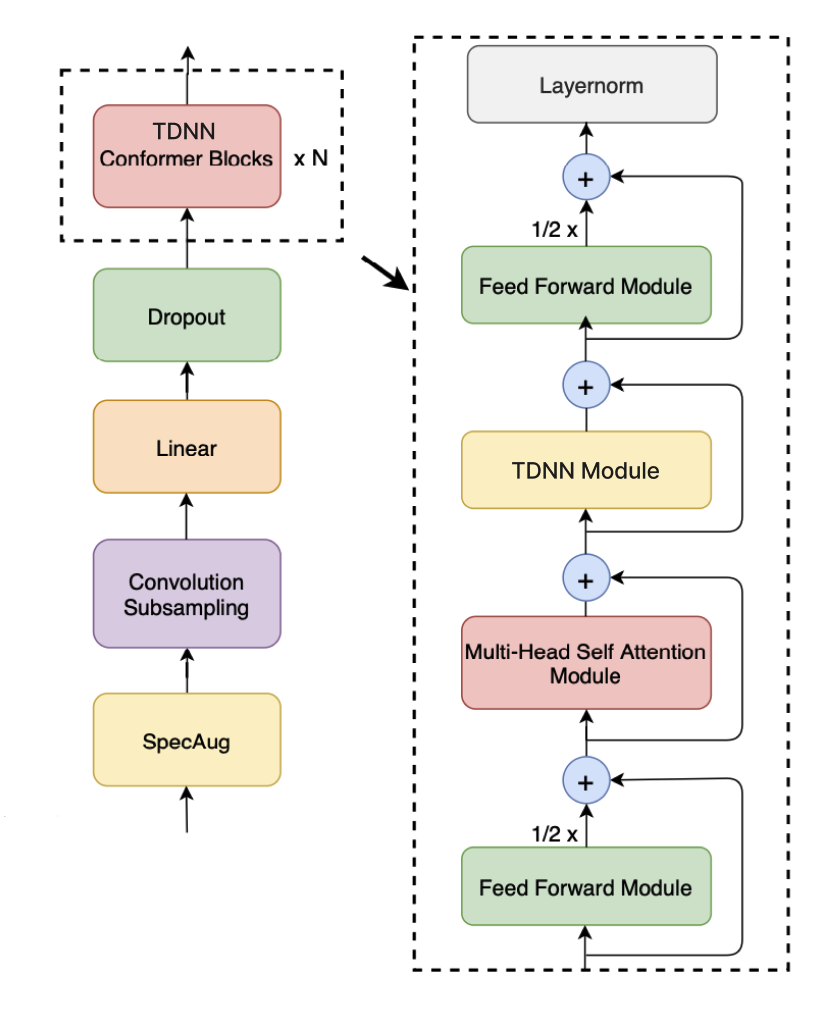
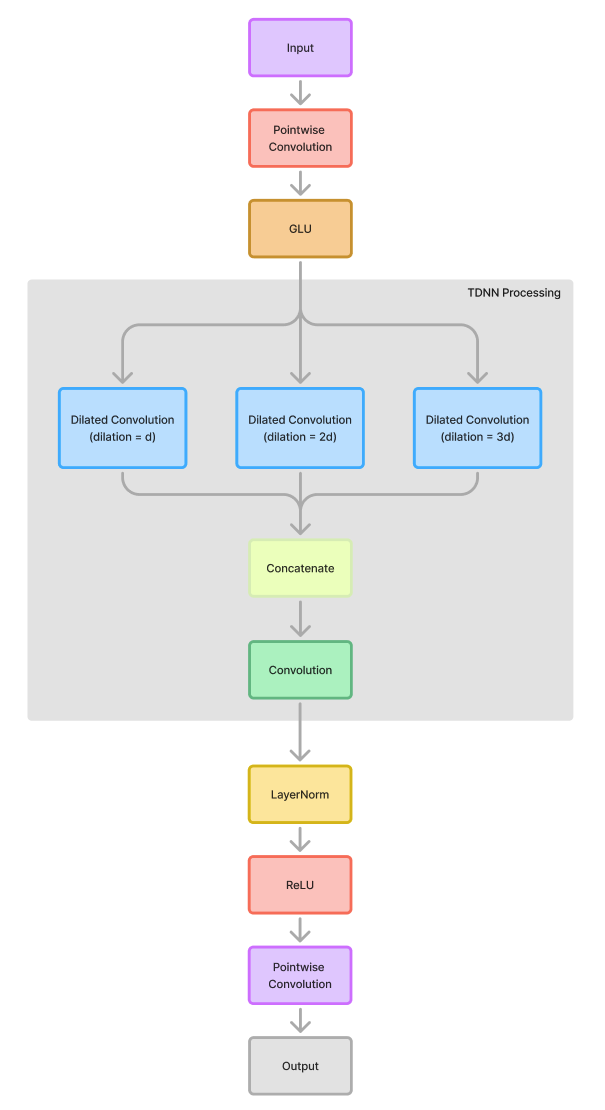
- ▹TDNN module internals: pointwise conv projects to the block width → GLU gate controls information flow → three depthwise convolutions run in parallel at increasing dilation (context sizes d, 2d, 3d) to capture short- and longer-range temporal patterns simultaneously → outputs concatenate and pass through a 1×1 merge conv, LayerNorm, ReLU, and a final pointwise conv
- ▹Training recipe: AdamW (β₁=0.9, β₂=0.98), Transformer learning-rate schedule with a 25,000-step warmup to a 0.001 peak, gradient clipping at 10.0, batch size 12
Highlights
- ▹Custom TDNN module: pointwise conv → GLU gating → three parallel dilated depthwise convolutions (dilations d, 2d, 3d) → concat → merge → LayerNorm → ReLU
- ▹6-block encoder (dim 256, 4 attention heads, relative positional encoding), 6-layer Transformer decoder, 12.5M parameters total
- ▹Trained with a hybrid CTC (0.3) / attention (0.7) loss, SpecAugment, speed perturbation, and label smoothing — the standard modern WeNet recipe
- ▹Grounded the architecture in the original TDNN literature (Waibel et al., 1989) and factorized-TDNN work (Povey et al., 2018), rather than an ad hoc design
Results
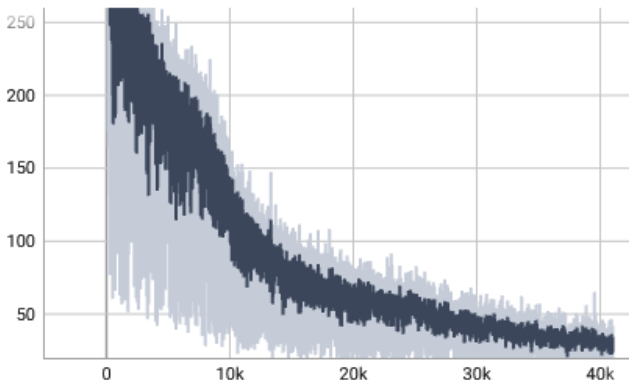
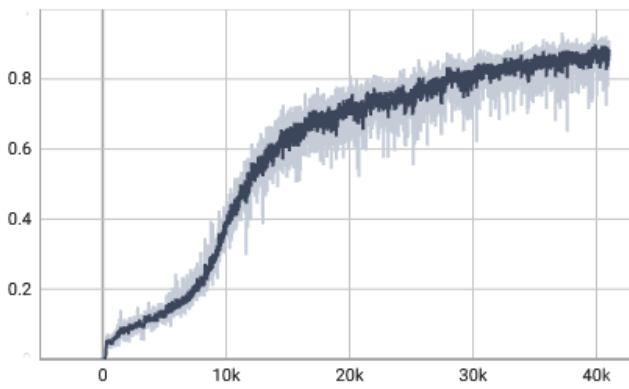
On LibriSpeech test-clean, the model reached 14.63% WER via CTC prefix beam search (its best decoding mode) after 35 hours of training on a single consumer GPU. The accompanying write-up is explicit that this trails baseline Conformer variants (2.1–2.7% WER, trained on 960 hours with far more compute) — the goal was an honest, controlled comparison of the architectural change, not a leaderboard result, and the paper says so directly rather than overselling it.